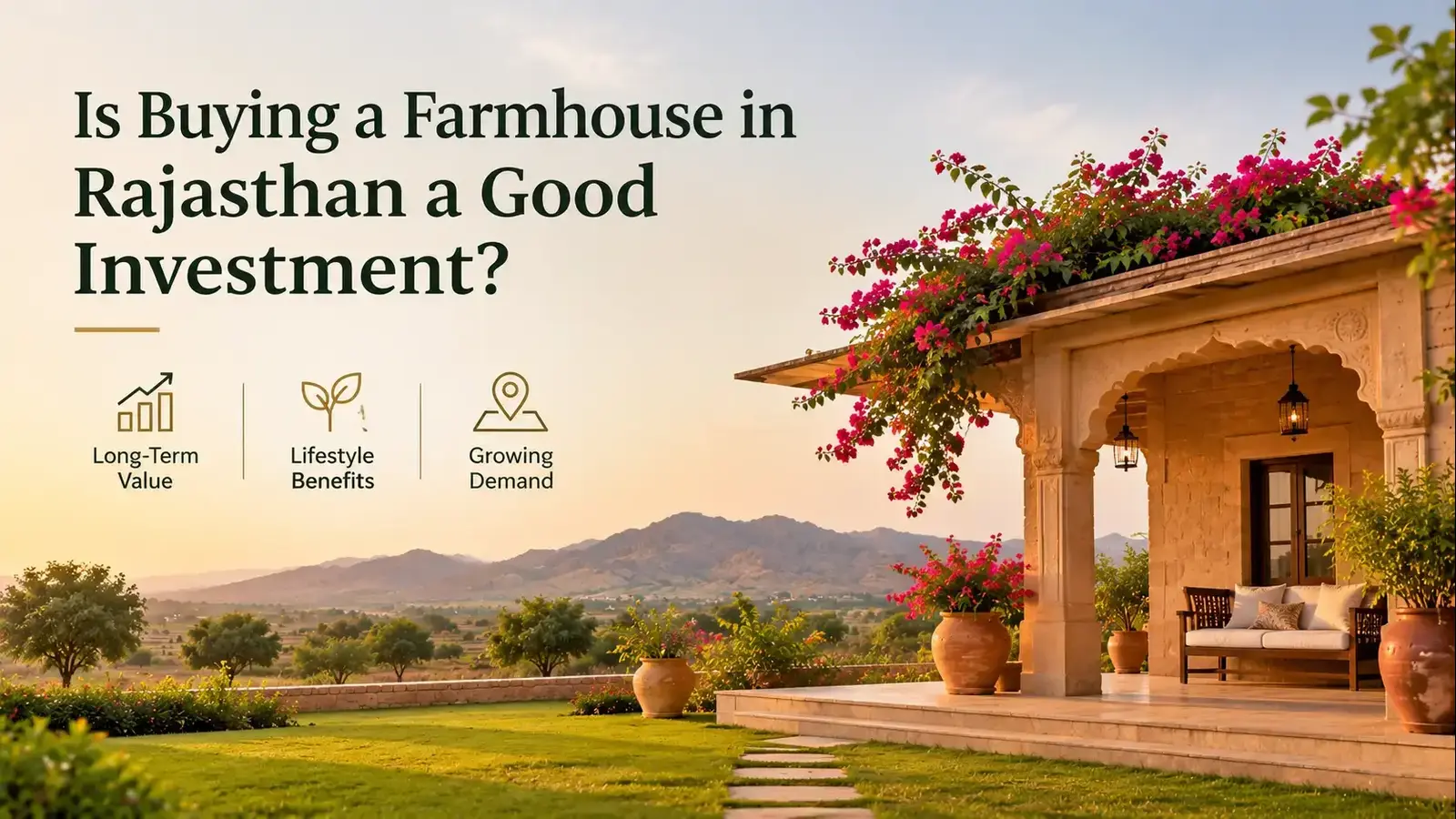
Is Buying a Farmhouse in Rajasthan a Good Investment?
Yes, buying a farmhouse in Rajasthan can be a worthwhile investment for buyers who prioritise land ownership, personal use and a long-term holding period. However, returns depend on local demand, infrastructure, legal compliance, ongoing expenses and the price paid.
Rajasthan offers diverse property settings, from areas around Jaipur and Dausa to rural destinations with agricultural landscapes. Each location serves different needs, so investors should assess individual properties rather than assume that the entire state offers the same investment potential.
A farmhouse may be suitable if you:
- Want a second home for weekend retreats and family gatherings.
- Prefer open surroundings and nature-oriented living.
- Can hold the property for several years without depending on immediate resale.
- Have budgeted for upkeep, utilities, security and other recurring expenses.
Why Consider a Farmhouse in Rajasthan?
1. Space and Nature-Centric Living
A farmhouse can provide private outdoor space, gardens and opportunities for recreational activities. For buyers seeking a slower pace of life, these features may offer value beyond the property's resale price.
The quality of the surroundings matters. Water availability, soil conditions, access roads, environmental constraints and the usability of the land should influence the buying decision.
2. Location and Connectivity
Good connectivity enhances the convenience and appeal of a farmhouse, making it easier to enjoy weekend getaways, family retreats and nature-inspired living. Locations with access to nearby towns, essential services and major road networks can offer a practical balance between peaceful surroundings and everyday convenience.
SOUL Vankriti, located in Dabar Khurd, Lalsot, in Rajasthan’s Dausa district, offers connectivity to key regional destinations. It is 9 km from Lalsot, 34 km from Dausa, 76 km from Jaipur and 67 km from Jaipur International Airport. This location provides a useful starting point for buyers seeking a nature-centric farmhouse experience within reach of established towns and Jaipur.
3. Potential for Long-Term Value
Land values can change as local infrastructure, services and demand evolve. However, these factors do not guarantee appreciation. A property in a remote location may remain difficult to sell if access, utilities or buyer demand are limited.
Investors should compare recent transactions involving similar properties and consider a realistic holding period instead of relying solely on projected future development.
4. Personal Use and Lifestyle Benefits
Unlike an investment purchased exclusively for financial returns, a farmhouse can serve as a private retreat for holidays, family gatherings or extended stays.
These personal benefits can make ownership worthwhile for some buyers. Nevertheless, they should be assessed separately from financial returns, particularly when comparing a farmhouse with other real estate investments.
What Factors Determine a Farmhouse's Investment Potential?
| Factor | What to evaluate |
|---|---|
| Location | Road access, nearby towns, essential services and local demand |
| Legal status | Title, land-use classification, applicable permissions and encumbrances |
| Infrastructure | Electricity, water, drainage, road access and security |
| Purchase price | Comparable transactions, development costs and applicable charges |
| Maintenance | Landscaping, repairs, utilities, staffing and community fees |
| Resale prospects | Likely buyer pool, transfer conditions and market liquidity |
A property that performs well across these factors may be a stronger candidate than one marketed primarily through luxury amenities or appreciation claims.
Legal Checks Before Buying a Farmhouse in Rajasthan
Legal due diligence is essential because agricultural land, residential plots and farmhouse developments may have different ownership and land-use requirements.
The Rajasthan Revenue Department publishes rules and notifications concerning land records and the conversion of agricultural land for non-agricultural purposes. Buyers should check the rules applicable to the specific parcel and intended use, including relevant amendments.
Before paying a booking amount or signing an agreement, verify:
- Ownership and title: Review the registered conveyance documents, revenue records, ownership history and any encumbrances.
- Land-use permissions: Confirm whether the proposed residential construction and intended use are legally permitted.
- Approvals and layout: Check applicable development, building and project approvals with the competent authorities.
- Access and boundaries: Verify the recorded boundaries, lawful access and any rights of way.
- Water and utilities: Establish the availability and legality of water sources, electricity connections and other essential services.
- Transfer conditions: Confirm any restrictions affecting ownership, resale or the transfer of the property.
Engage an independent property lawyer and, where appropriate, a local land-records professional. Do not rely solely on a developer's brochure or verbal assurances.
What Are the Risks of Buying a Farmhouse?
Farmhouse ownership involves risks that buyers should understand before committing their capital.
Limited liquidity: Rural properties may take longer to sell than properties in established residential markets. The resale pool can be narrower, depending on location and price.
Recurring expenses: Landscaping, repairs, security, utilities and community maintenance can increase the total cost of ownership.
Infrastructure constraints: Poor road access, unreliable water supply or limited nearby services may affect usability and resale appeal.
Regulatory uncertainty: Incorrect land-use assumptions or incomplete approvals can create legal and financial complications.
Uncertain returns: Capital appreciation and rental income are not guaranteed. Buyers should avoid relying on projected returns without verifiable market evidence.
A sensible investment assessment should account for the full ownership cost, a conservative resale scenario and the possibility that the property may not generate income.
SOUL Vankriti: A Nature-Led Farmhouse Community in Rajasthan
SOUL Vankriti, a project by SOUL Agrofarms, is located in Dabar Khurd, Lalsot, in Rajasthan's Dausa district. According to the developer, its first phase comprises 50 farmhouses, each planned with a 1,000-square-yard private land parcel and a 900-square-foot, one-bedroom villa. Its concept combines private space with planned nature, wellness, recreation and community amenities.
For buyers considering a farmhouse in Rajasthan, Vankriti provides an example of a development that places the surrounding landscape alongside the built home. Prospective buyers should independently verify project approvals, ownership terms, construction specifications, infrastructure delivery and maintenance arrangements before making a decision.
Explore SOUL Vankriti to learn more about its nature-led approach to farmhouse living.
Rajasthan Farmhouse vs. Other Real Estate Investments
A farmhouse is not automatically better than an apartment, residential plot or commercial property. The right choice depends on the buyer's objectives.
| Investment consideration | Farmhouse | Apartment or residential plot |
|---|---|---|
| Primary appeal | Space, privacy and lifestyle | Residential use or land ownership |
| Maintenance | May involve substantial land and outdoor upkeep | Depends on property type and community arrangements |
| Income potential | Depends on lawful use and demonstrated rental demand | Depends on location, property type and local demand |
| Resale liquidity | Can be limited in some rural markets | Varies considerably by market and property |
| Legal due diligence | Requires careful verification of land use and construction permissions | Requires title, approvals and applicable land-use checks |
Compare properties using total ownership costs, realistic demand and your intended holding period rather than headline prices alone.
Conclusion: Should You Invest in a Farmhouse in Rajasthan?
Buying a farmhouse in Rajasthan can make sense if you value nature-centric living, have a suitable long-term budget and select a property with sound legal documentation and practical connectivity. It is less suitable for buyers who need quick resale, dependable short-term returns or income without active management.
Before investing, compare local property prices, verify approvals, calculate recurring expenses and assess the property's realistic resale prospects.
For those exploring thoughtfully planned farmhouse communities, SOUL Vankriti offers a nature-led concept worth exploring alongside independent legal and financial due diligence.
Frequently Asked Questions
1. Is buying a farmhouse in Rajasthan a good investment for the long term?
It can be, provided the property has clear title, appropriate permissions, usable infrastructure and a purchase price supported by comparable market evidence. Long-term appreciation remains uncertain.
2. Which factors matter most when buying a farmhouse in Rajasthan?
Location, legal status, land-use permissions, water availability, road connectivity, maintenance costs and resale demand are among the most important considerations.
3. Can I earn rental income from a farmhouse in Rajasthan?
Potentially, but income depends on local demand, lawful property use, applicable permissions, operating costs and occupancy. Buyers should verify these factors rather than assume that rental income will cover ownership expenses.
4. Can agricultural land be used to build a farmhouse in Rajasthan?
Not automatically. Permitted construction and land use depend on the applicable laws, land classification and required approvals. Verify the position with the competent local authority and an independent property lawyer before purchasing.
5. What should I check before buying a farmhouse in Dausa or Lalsot?
Review title and revenue records, land-use permissions, approved layouts, road access, water and electricity availability, total ownership costs and comparable property transactions. Verify advertised travel distances and project specifications independently.