Farmhouse vs Apartment: Which is Better Investment?
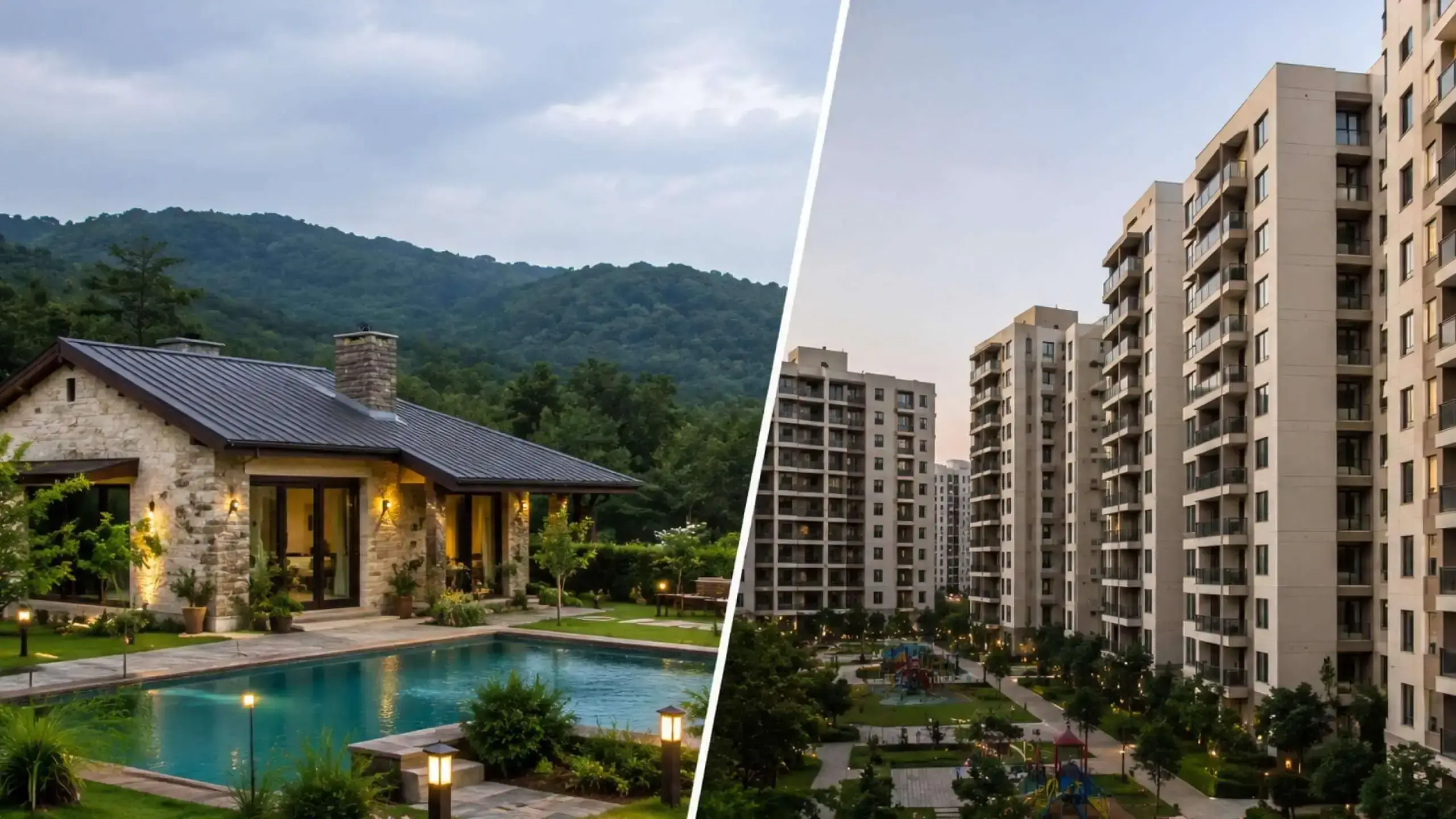
Real estate investment often comes down to choosing the right type of property, and the decision between a farmhouse and an apartment can be challenging. While a farmhouse offers privacy, open spaces, and potential land value appreciation, an apartment may provide better rental demand, modern amenities, and easier property management.
The good news is that there is no one-size-fits-all answer. The better investment depends on your budget, financial goals, preferred location, expected rental income, and investment horizon. In this guide, we will compare Farmhouse vs Apartment across key factors such as purchase cost, rental potential, appreciation, maintenance, liquidity, and resale value.
By the end, you will have a clearer understanding of Farmhouse vs Apartment investment and be better equipped to decide which property type aligns with your real estate investment goals.
Farmhouse vs Apartment: Understanding the Difference
Before deciding which is a better investment, it is important to understand how farmhouses and apartments differ as real estate assets.
What Is a Farmhouse Investment?
A farmhouse typically combines a residential structure with a larger plot of land and open outdoor space. These properties are generally located on the outskirts of cities, near scenic destinations, or in developing areas where larger land parcels are available.
Farmhouses can serve multiple purposes. Investors may use them as weekend homes, private retreats, holiday rentals, or long-term assets. Their investment potential is often linked to both the property and the underlying land value.
For buyers exploring lifestyle-oriented property options, Farmhouses in Haridwar can be considered based on factors such as location, accessibility, surrounding environment, intended use, and applicable local regulations.
However, the investment performance of a farmhouse depends heavily on factors such as location, legal land use, accessibility, infrastructure, and local demand.
What Is an Apartment Investment?
An apartment is a residential unit within a larger housing development or building. Apartments are commonly located in urban areas, established residential neighbourhoods, or emerging growth corridors.
Apartments are popular among homebuyers and investors because they often offer access to facilities such as security, parking, fitness centres, landscaped areas, and community spaces. They can also be attractive for rental investment, particularly when located near employment hubs, educational institutions, transportation networks, or commercial centres.
Farmhouse vs Apartment: Key Factors to Compare
1. Initial Investment and Purchase Cost
The initial cost is one of the first factors investors consider.
A farmhouse may require a significant investment depending on the size of the land, construction quality, location, and additional facilities. Buyers may also need to account for expenses related to landscaping, fencing, utilities, and ongoing improvements.
Apartments, on the other hand, are available across a wider range of budgets. Buyers can choose from different configurations, locations, and project types based on their financial capacity.
Therefore, apartments may be more accessible to first-time investors, while farmhouses may appeal more to buyers with larger budgets who are looking for land and lifestyle value.
2. Rental Income Potential
Rental income is an important consideration when investing in real estate.
Apartments generally have a broader rental market because tenants often prefer properties close to offices, schools, colleges, shopping areas, and public transportation. A well-located apartment can potentially generate consistent rental demand.
Farmhouses usually have a more specialised rental market. Depending on the location, they may attract weekend visitors, tourists, families, or groups looking for short-term stays. However, rental income can be more seasonal and may require active property management.
If your primary objective is stable long-term rental income, an apartment in a high-demand location may be the more practical option. If you are interested in short-term or experiential rentals, a well-located farmhouse could offer a different investment opportunity.
Lifestyle-focused farmhouse developments such as SOUL Agrofarms may also appeal to buyers who are evaluating properties for personal use, leisure, or a farmhouse-oriented lifestyle. However, buyers should independently assess the property's legal status, location, facilities, and suitability for their specific objectives before investing.
3. Appreciation Potential
Property appreciation depends largely on location, infrastructure, economic development, and demand.
Farmhouses can benefit from rising land values, particularly when located in areas experiencing infrastructure development, improved connectivity, or increasing tourism activity. However, appreciation is not guaranteed, and investors should carefully assess the legal status and development prospects of the location.
Apartments may appreciate when they are situated in established or rapidly developing areas with strong connectivity and employment opportunities. However, the age of the building, new project supply, maintenance quality, and overall market demand can influence long-term value.
The key takeaway is that location often matters more than property type when evaluating appreciation potential.
4. Maintenance and Operating Costs
Maintenance is another important difference between farmhouses and apartments.
Farmhouse owners are typically responsible for maintaining the entire property. This may include the building, gardens, boundary walls, private roads, water systems, security, and other facilities. Larger properties can therefore involve higher maintenance responsibilities.
Apartment owners usually pay monthly maintenance or society charges. These fees contribute towards common-area maintenance, security, lifts, landscaping, and other shared facilities.
For investors who prefer a relatively hands-off ownership experience, apartments may be easier to manage. Farmhouses can require more time, attention, and operational expenses.
5. Liquidity and Resale Value
Liquidity refers to how easily an investment can be sold when the owner wants to exit.
Apartments generally have a larger pool of potential buyers, especially in established residential markets. This can make resale relatively easier when the property is well-located and reasonably priced.
Farmhouses may have a smaller buyer pool because the purchase involves a higher lifestyle component and, in some cases, more complex legal or land-related considerations.
Therefore, investors who prioritise liquidity and easier resale may find apartments more suitable.
6. Location and Connectivity
Location is critical for both types of investments.
For apartments, proximity to metro stations, highways, business districts, schools, hospitals, and shopping centres can influence rental demand and resale value.
For farmhouses, connectivity to major roads, airports, highways, and tourist destinations can be particularly important. A farmhouse that is too remote may face challenges related to accessibility and rental demand.
Before investing, buyers should evaluate both current connectivity and planned infrastructure development. However, future infrastructure should be treated as a potential factor rather than a guaranteed return.
For example, buyers considering Farmhouses in Haridwar should evaluate the property's access to major roads, nearby services, surrounding development, and the intended purpose of the investment before making a decision.
7. Legal and Regulatory Considerations
Legal due diligence is essential before purchasing any property, but it can be particularly important for farmhouse investments.
Buyers should verify ownership documents, land title, land-use permissions, zoning regulations, construction approvals, and applicable local laws. The rules governing agricultural land and farmhouse construction can vary by state and location.
For apartments, buyers should verify the project's approvals, developer credentials, title documents, applicable RERA registration where required, and the terms of the sale agreement.
Never make a property investment decision based solely on expected appreciation. Legal verification and professional advice are essential before completing a transaction.
8. Lifestyle and Personal Use
The intended use of the property can significantly influence the decision.
A farmhouse may be ideal for buyers who value privacy, open spaces, gardens, and weekend retreats. It can provide a more spacious environment for personal use and leisure activities.
An apartment is generally better suited for people who prioritise convenience, security, community living, and access to urban amenities.
Therefore, if lifestyle and personal enjoyment are major priorities, a farmhouse may be attractive. If convenience and everyday urban living are more important, an apartment could be a better fit.
Farmhouse vs Apartment: Investment Comparison
| Factor | Farmhouse | Apartment |
|---|---|---|
| Initial Investment | Often higher depending on land and construction | Available across different budgets |
| Rental Demand | Location-specific and often seasonal | Generally broader in urban and employment hubs |
| Appreciation | Can benefit from land value and location growth | Depends on location, project quality, and demand |
| Maintenance | Usually higher and owner-managed | Shared maintenance through society |
| Liquidity | May be lower in specialised markets | Generally better in established locations |
| Privacy | High | Moderate |
| Amenities | Privately developed | Often provided through the project |
| Personal Use | Suitable for weekend and leisure use | Better suited for everyday living |
| Legal Complexity | Can be higher due to land-use considerations | Generally more structured, but due diligence remains essential |
| Ideal For | Lifestyle buyers and long-term land-focused investors | Rental investors, first-time buyers, and urban homebuyers |
Which Is Better for Different Types of Investors?
For First-Time Investors
Apartments may be a more practical choice for first-time investors because they are easier to understand, manage, rent, and resell in established markets.
For High-Net-Worth Individuals
Farmhouses may appeal to HNIs looking for privacy, larger spaces, and lifestyle-oriented properties. However, the investment should still be evaluated based on location, legal compliance, and long-term demand.
For Rental Income Seekers
Investors seeking regular rental income may prefer apartments located near employment centres, educational institutions, transportation hubs, or commercial areas.
Farmhouses may be suitable for investors pursuing short-term rentals in tourist or leisure destinations, although this model may require more active management.
For Long-Term Capital Appreciation
Both property types can appreciate, but the location and surrounding development are critical. Investors should analyse infrastructure, connectivity, demand, supply, and future growth potential rather than assuming one property type will always outperform the other.
For Weekend or Holiday Use
For personal retreats, weekend homes, and leisure-oriented use, a farmhouse may offer greater space and privacy than an apartment. Buyers exploring options such as Farmhouses in Haridwar may find this format relevant for personal use, subject to location, legal, and property-specific considerations.
Farmhouse vs Apartment: Which Is Better Investment?
There is no universal answer to the question of whether a farmhouse or apartment is the better investment.
An apartment may be the better choice if your priorities are rental income, convenience, easier management, urban connectivity, and relatively better liquidity.
A farmhouse may be more suitable if your priorities include privacy, open space, personal use, and potential land value appreciation in a well-selected location.
Ultimately, the best investment is the one that aligns with your financial goals, budget, investment horizon, and risk tolerance. A property with strong fundamentals in the right location can often be a better investment than simply choosing between a farmhouse and an apartment based on property type alone.
Conclusion
The debate between Farmhouse vs Apartment ultimately depends on what you expect from your real estate investment. Apartments can offer convenience, rental demand, organised maintenance, and potentially better liquidity, making them suitable for many investors. Farmhouses, meanwhile, can provide privacy, lifestyle benefits, and exposure to land value in carefully selected locations.
Before making a decision, evaluate the property's location, legal status, connectivity, rental demand, maintenance requirements, and resale potential. Rather than choosing a property solely because of its type, focus on the fundamentals that can influence its long-term performance.
For buyers considering lifestyle-oriented property options, SOUL Agrofarms and Farmhouses in Haridwar can be explored as part of the broader farmhouse investment landscape, with proper attention to legal due diligence, location, and individual investment objectives.
With thorough research and proper due diligence, both farmhouses and apartments can have a place in a diversified real estate investment strategy.